2022 Researcher-Practitioner Collaboration Grant recipient (with Susan Fager): Exploration of Augmentative and Alternative Communication Training Supports for Health Care Providers 2021 New Investigators Research Grant recipient: Teaching Acute Care Providers to Use Visual Supports and Create Communication Opportunities in Healthcare Routines: Effects of a Just-in-Time AAC Training 2018 New Century Scholars Doctoral Scholarship recipient
Tell us about your work.
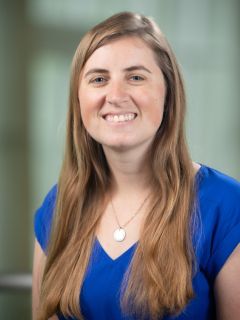 The project is really about making sure healthcare teams, kids, and families have what they need to communicate successfully in hospitals. I’ve been a clinician since 2010 and have worked in a lot of different healthcare settings, mostly inpatient, and I realized that many Augmentative and Alternative Communication (AAC) systems aren’t designed for hospital environments. Kids might come in without the systems they use at home, or suddenly need different communication supports—maybe they have a recent brain injury, or they’re on a ventilator. There’s so much that’s unpredictable, so we wanted to make sure there was some consistency in the environment and that kids had the tools they needed, and providers knew how to use them.
I’ve done trainings where I teach someone an AAC technique, but once they get into the child’s room, there’s nothing there to support it. We needed to combine forces so that providers had actual resources they could use—and if those resources weren’t in the room, they knew where to get them. That way they could bring tools in themselves and use something consistent to support communication, participation, and even language development.
In healthcare, we often start with low-tech options because of infection control issues or concerns about devices getting lost or misused. Our toolkits were mostly low-tech: communication boards with vocabulary related to hospital routines and items kids might not be familiar with. Maybe a child is still learning what “suction” means, or what their medicine looks like, or that it goes through a tube instead of being eaten. We worked with families and healthcare providers to figure out the most important vocabulary and created photo-based representations using images from the simulation lab and hospital rooms.
We also created “About Me” pages with kids’ favorite things or things they’re motivated by. Between the toolkits, the “About Me” items, and materials we can make on the fly, we’re able to support communication in ways that really matter to kids in the hospital.
What sparked your interest in this topic?
I knew I was interested in the therapy world back in high school, but I didn’t really understand all the different opportunities. I did a lot of observations, and the first time I saw someone use a high-tech AAC device, I thought, oh, speech pathology is for me. I’ve always wanted to help people have a voice and participate in whatever they want to do, however they want to do it, and AAC felt like the perfect fit.
It’s funny that I ended up in healthcare, because, when I started out, AAC wasn’t being used much in hospitals. I kept seeing people who would benefit from it, but we didn’t have the materials, and not everyone felt confident using AAC. A lot of my career has been about making things—literally creating resources—and figuring out how to make them fit into different healthcare workspaces. As I worked across settings, I realized how hard communication in hospitals really was, and how many people were struggling without the tools or team support they needed.
Without these supports, there can be real consequences. Adults with communication disabilities are three times more likely to experience preventable adverse events. Healthcare experiences can be negative when communication breaks down. And for kids—especially those hospitalized for long periods—the impact can be long-lasting. It can affect communication development, learning, and self-advocacy. Kids and adults often report becoming very passive communicators; things happen to them, but they’re not part of the process. They may feel unheard or undervalued, and that can snowball into a really frustrating experience.
What impact do you hope your work will have?
What we’re hoping is that by giving people the tools they need, right when they need them—and making sure those tools actually fit their setting—they’ll be more likely to try AAC. One of the hardest things about AAC is just knowing where to start. People get nervous or aren’t sure what to do, so we want to create a level playing field and a clear starting point. We also want to show that those small communication moments really matter— asking a question, offering a choice, acknowledging a child’s message. Those little moments can have a powerful impact and help someone feel like they matter.
The tools aren’t a one-size-fits-all solution, and they won’t completely change the hospital experience. However, those consistent small interactions can build trust, support coping, and help set kids up for success—both in communication and feeling heard.
We’ve piloted this work in the pediatric intensive care unit (ICU) and pediatric units at the University of Nebraska Medical Center (UNMC). I also work clinically with adults, and we quickly saw that we couldn’t just apply a pediatric lens to adult care. So, we’ve started expanding similar toolkits across the hospital. Now we have adult ICU toolkits that have been translated into seven of the top languages spoken in our hospital. We also have online trainings on our hospital learning management system and the “Communicating Choices in the Hospital” just-in-time training is now freely available online.
How is your approach innovative?
I think one innovative part of our approach is really contextualizing AAC supports within this very understudied environment. We’re asking: What hospital routines matter? What vocabulary do kids actually need? How do we engage the healthcare team so everyone’s needs are met? With how much healthcare has changed in the past few years, we need to be able to ask the right questions quickly and create communication opportunities that truly matter.
The just-in-time element is also a big innovation. You can create something power-packed in a few minutes, build behavioral momentum, or learn something new from the patient and adjust on the spot. A five-minute training won’t derail a 12-hour shift, and our nursing staff has said it feels doable and feasible.
With my colleagues Dr. Mary Halbur, Dr. Regina Carroll, Maryjan Fiala, Melanie Davis, Guangyi Lin, and Marisol Loza Hernandez, we’ve also built a video-based course—a micro-credential on enhancing care for kids with disabilities—that includes a very short AAC module using the video elements created by projects sponsored by the ASHFoundation. We’ve started to integrate it into our curriculum at the Munroe-Meyer Institute, and preservice learners—future physicians, nurses, and allied health professionals—have said it’s incredibly helpful to have these tools before they even enter the clinical setting.
And the work is spreading: a group in Wisconsin, led by Rebecca Jarzynski and Michael Feldhacker, used some of the materials from my dissertation, supported by the ASHFoundation’s New Century Scholars Doctoral Scholarship, in an interdisciplinary nursing and speech event.
What challenges did you face in conducting your research, and how did ASHFoundation support your efforts?
My proposal required me to be in the hospital whenever people were available, so the ASHFoundation funding really allowed me to “live” in the hospital for six weeks to get this done. Because I was essentially a fly on the wall watching real interactions, I needed to be available whenever they happened. I couldn’t have gathered that level of experience—or pushed my thinking beyond my usual speech-language pathologist (SLP) lens—without that support.
The funding also helped me get the supplies I needed and have dedicated time to focus on the project. The New Investigators Research Grant, which happened during the pandemic when everything was hard, made it possible to compensate people for their time and expertise.
This support also allowed us to create high-quality video. We used our simulation lab, which looks exactly like our ICU and pediatric rooms, so we could record natural interactions with kids who have disabilities, their families, and SLPs demonstrating strategies. That would not have been possible without the grant. It made the work easier to share and much more legitimate than me trying to film things on my iPhone. The support let me focus on the research and building partnerships instead of being stuck in the video-editing room.
View More Recipient Spotlights